Forging & Heat Treatment: Strength, Grain & What Comes After Forging
Forging is how you get a stronger, tougher part than casting alone — and heat treatment is what finishes it. This guide explains how forging works, why it improves strength, and which heat treatments are applied to forged or cast components.
What Is Forging?
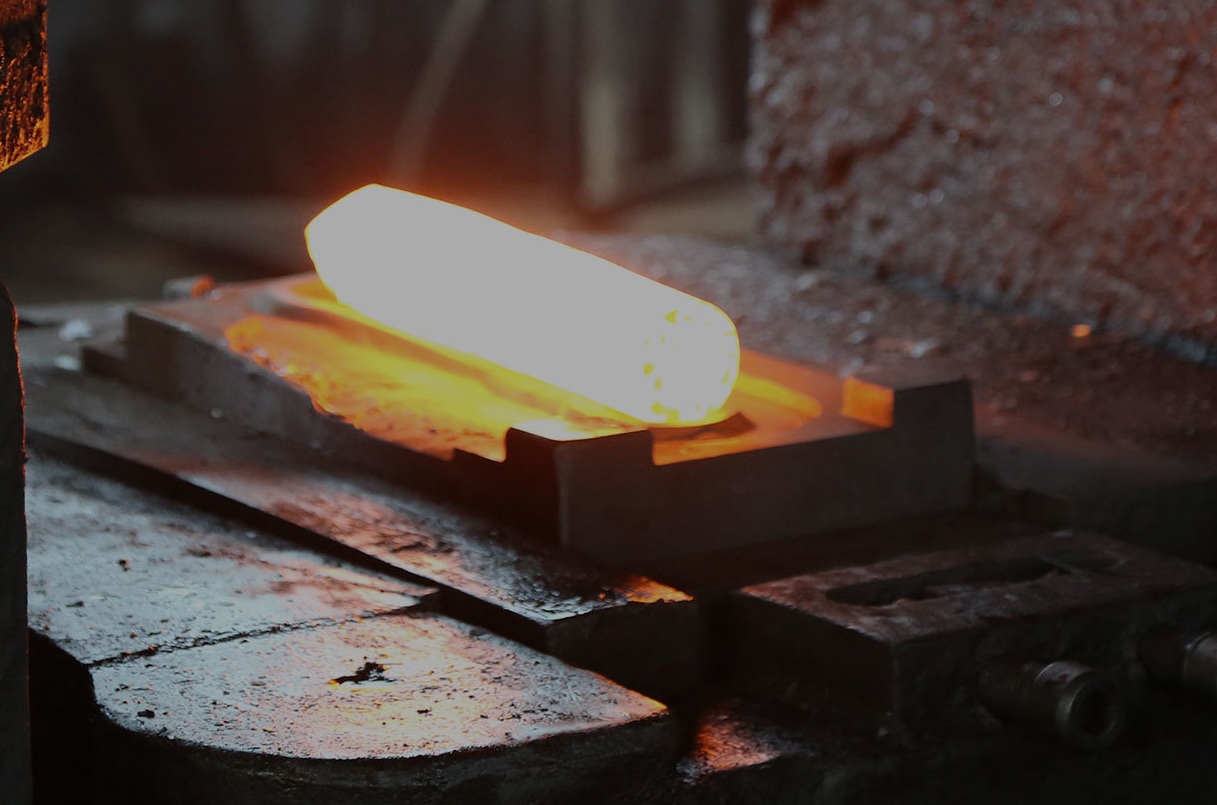
Forging is shaping metal under high pressure — typically at elevated temperature — using hammers or presses. Instead of pouring molten metal into a mould, a solid billet of steel is squeezed into the required shape. Because the metal is worked while plastic, forging refines its internal grain structure and realigns grains to follow the part's shape, which dramatically improves strength and toughness.
That grain flow is the key advantage: a forged component resists fatigue and impact far better than one with an "as-cast" or machined-from-solid structure.
Forging vs Casting in One Table
| Characteristic | Forging | Investment casting |
|---|---|---|
| Grain structure | Refined, follows part shape | As-cast, isotropic |
| Strength & toughness | Higher (especially dynamic) | Good, lower than forged |
| Complexity | Limited by die shape | Very high — internal cavities etc. |
| Material waste | Low (near net shape) | Low–medium |
| Best for | High-load shafts, structural parts | Complex, corrosion-resistant parts |
How Heat Treatment Fits In
Forged (and cast) parts usually need heat treatment to reach their final mechanical properties. Heat treatment uses controlled heating and cooling to change the metal's microstructure:
- Normalizing — refines grain and relieves internal stress after forging or casting.
- Quenching — rapid cooling to harden the steel for wear and strength.
- Tempering — a controlled reheat after quenching to balance hardness with toughness and relieve brittleness.
- Solution treatment & aging — used for stainless and precipitation-hardening grades to develop corrosion resistance and strength.
The Forging Decisions That Matter
- Which material? — carbon and alloy steels are commonly forged; some superalloys can also be forged.
- Open or closed die? — open-die suits large, simple shapes; closed-die gives near-net shape and higher precision.
- Hot or cold? — hot forging (typical for steel) allows large deformation; cold forging gives better surface and dimensional accuracy on smaller parts.
- What finish? — forgings usually need some machining, then surface finishing and heat treatment.
Why it matters for buyers
If your part takes heavy, repeated or shock loads — shafts, gears, axles, connecting rods — forging plus correct heat treatment is usually the right call. For complex geometry or corrosion duty, investment casting is often better. The wrong choice shows up as early failure in service.
At GRDH Precision
We combine these capabilities in one chain: investment casting up to 622 kg, forging, precision CNC machining (linear tolerance GB/T 1800.1 grade 5–7), and precise heat treatment using automated controlled-atmosphere furnaces and high-temperature solution-treatment furnaces. That means your part can be forged, heat-treated, machined and finished under one roof.
Deciding between forging, casting or CNC depends on your part's load, geometry and volume — send us the details and we'll recommend the route.
Should your part be forged or cast?
Send your drawing and describe the operating load. We'll recommend the process, heat treatment and readiness — then quote transparently.
Start a Project →← Back to Blog · Related: Casting vs Forging vs CNC · Surface Finish Ra · Our Forging Capability