Investment Casting (Lost Wax) Process Explained Step by Step
Investment casting — also called lost-wax casting or precision casting — is how complex, near-net-shape parts are made from stainless and alloy steels. Here is exactly what happens, in order, from wax to finished casting.
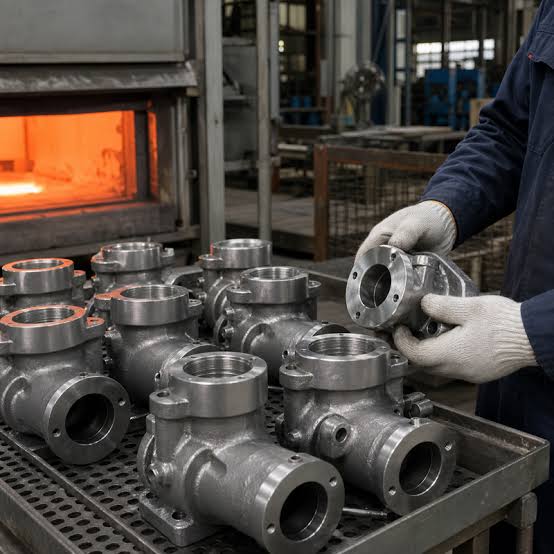
Why Choose Investment Casting?
Investment casting produces parts that other methods cannot make economically — thin walls, internal cavities, fine detail and complicated 3D geometry. Because the wax pattern is destroyed each time, there is no "die" locking the shape, so the process suits both low volume (prototypes and small batches) and high volume.
- Complex geometry — undercuts, internal passages, thin sections.
- Good surface finish — typically better than sand casting, reducing machining.
- Dimensionally accurate — often to ISO 8062 DCTG 4–6, making many surfaces usable as-cast.
- Wide material range — carbon and stainless steels, alloy steels, nickel/cobalt superalloys and non-ferrous alloys.
The Step-by-Step Process
Wax injection (pattern making)
Molten wax is injected into a metal die under pressure, then cooled to create an exact wax replica of the part. Multiple patterns are attached to a wax central sprue to form a "tree", so many parts can be cast at once.
Shell building
The wax tree is repeatedly dipped in a ceramic slurry and coated with fine sand, then dried. Each dip adds one layer. Applied layer by layer, the shell builds into a hard ceramic mould — typically 4 to 8 layers — that will withstand the heat of molten steel.
Dewaxing
The ceramic shell is heated so the wax melts and drains out, leaving an empty cavity that is an exact negative of the parts. The wax can be recovered, cleaned and reused.
Preheating & pouring
The hollow shell is fired to high temperature to make it strong and to remove any remaining wax. Molten metal is then poured into the hot shell. For air-sensitive alloys such as nickel and cobalt superalloys, pouring is done in a vacuum furnace to prevent oxidation.
Shell removal
Once the metal has solidified and cooled, the ceramic shell is knocked or blasted away, and the individual castings are cut off the sprue.
Finishing & inspection
Castings are cleaned, blast-finished, and any gates or residues removed. Then they are checked — visually and dimensionally — and heat-treated where the material requires it before shipment.
A note on our equipment
At GRDH Precision the process is automated and controlled: automatic wax-injection machines with group control, robotic shell-building manipulators, temperature/humidity-controlled drying, a high-pressure water cleaning cell and automated cutting/shot-blasting equipment. This predictability is what lets us hold repeatable quality over large runs.
What Investment Casting Is Good At
| Application | Why it fits |
|---|---|
| Valve bodies & components | Internal flow passages and complex port geometry |
| Pump components | Corrosion resistance + accurate impeller/blade shapes |
| Structural & mechanical parts | Complex shapes without the cost of machining away solid stock |
| Superalloy components | Vacuum casting of nickel/cobalt alloys that cannot be air-cast |
Part Size and Weight Limits
Investment casting handles a very wide range. As a durable reference: single-part weights from about 0.001 kg up to 622 kg, and parts up to roughly Ø710 mm × 300 mm, with the largest single dimension around 1200 mm. Confirm the exact envelope with your supplier for your specific alloy and geometry.
Have a part to cast?
Send your drawing. We'll confirm whether investment casting suits your geometry, alloy and volume — and quote transparently.
Start a Project →← Back to Blog · Related: How to Choose a Casting Material · Vacuum Casting Explained · Casting vs Forging vs CNC · Our Investment Casting Capability