Pre-Shipment Inspection in China: A Complete Quality Control Guide
Pre-shipment inspection (PSI) is the final quality gate before your goods leave China. This guide covers what to inspect, AQL sampling, methods, cost, and how to make PSI work for industrial metal parts.
TL;DR — Key Takeaways
- PSI is performed when production is 100% complete and 80%+ packed, at the supplier's factory.
- Use AQL sampling (ISO 2859) — AQL 0.65–1.0 for industrial metal parts.
- Check: quantity, packaging, visual, dimensions, material (PMI), hardness, surface finish, NDT, docs.
- Cost: $150–$350/man-day for general; $300–$600 for technical NDT inspection.
- For technical parts, use a technical sourcing partner — general inspectors don't understand metal specs.
1. What Is Pre-Shipment Inspection?
Pre-shipment inspection (PSI) is a quality control check performed on finished goods at the supplier's factory before they are packed and shipped. The goal is simple: verify that the goods meet your specifications, and catch any defects while they are still in China — where rework or replacement is fast and cheap.
Without PSI, you are essentially betting that the supplier's own QC caught everything. For low-value consumer goods, that risk may be acceptable. For industrial metal parts — where a single defective casting can cause equipment failure, safety incidents, or costly downtime — PSI is not optional.
2. The Inspection Timeline
PSI is the final check, but it should not be your only check. A complete quality control program has multiple inspection stages:
| Stage | When | What It Covers |
|---|---|---|
| Raw Material Inspection (RMI) | Before production | Material certificate, PMI test, heat number traceability |
| During Production Inspection (DPI) | 20–50% production | Process checks, first-piece inspection, in-process dimensions |
| Pre-Shipment Inspection (PSI) | 100% production, 80%+ packed | Full AQL inspection: quantity, quality, packaging, docs |
| Container Loading Supervision (CLS) | At loading | Container condition, proper loading, sealing |
3. AQL Sampling: How Many Pieces to Inspect
Inspecting every piece in a large batch is impractical and unnecessary. The AQL (Acceptable Quality Limit) method, defined in ISO 2859-1 / ANSI Z1.4, provides a statistically sound sampling plan.
The AQL table tells you, for a given lot size and inspection level, how many samples to draw and the maximum number of defects allowed (acceptance number). The most common inspection level is General Inspection Level II.
AQL Reference Table (General Level II)
| Lot Size | Sample Size | AQL 0.65 (Ac/Re) | AQL 1.0 (Ac/Re) | AQL 2.5 (Ac/Re) |
|---|---|---|---|---|
| 51–90 | 13 | 0/1 | 0/1 | 1/2 |
| 91–150 | 20 | 0/1 | 1/2 | 1/2 |
| 151–280 | 32 | 1/2 | 1/2 | 2/3 |
| 281–500 | 50 | 1/2 | 2/3 | 3/4 |
| 501–1,200 | 80 | 2/3 | 3/4 | 5/6 |
| 1,201–3,200 | 125 | 3/4 | 5/6 | 7/8 |
| 3,201–10,000 | 200 | 5/6 | 7/8 | 10/11 |
How to read: For a lot of 500 pieces at AQL 1.0, inspect 50 samples. If you find 2 or fewer defects, accept. If 3 or more, reject. (Ac = acceptance number, Re = rejection number.)
Choosing the Right AQL Level
• AQL 0.065–0.15: Medical devices, aerospace, safety-critical parts
• AQL 0.4–0.65: Industrial metal parts, valves, hydraulic components
• AQL 1.0–1.5: General mechanical parts, non-safety structural components
• AQL 2.5–4.0: Low-criticality hardware, brackets, fasteners
4. What Pre-Shipment Inspection Checks
A comprehensive PSI for industrial metal parts should cover the following:
Quantity & Packaging
- Verify total quantity matches the purchase order
- Check packaging method, material, and labeling (part number, PO, country of origin)
- Verify export packing is suitable for sea/air freight (fumigation, moisture barrier, dunnage)
- Check marking on parts: heat number, part number, serial number if required
Visual Inspection
- Surface finish, color, texture — compare to approved sample or spec
- Surface defects: cracks, porosity, cold shuts, inclusions, burns, scratches
- Parting line flash, gate marks, grinding quality
Dimensional Inspection
- Key dimensions per drawing — critical dimensions 100%, others per AQL
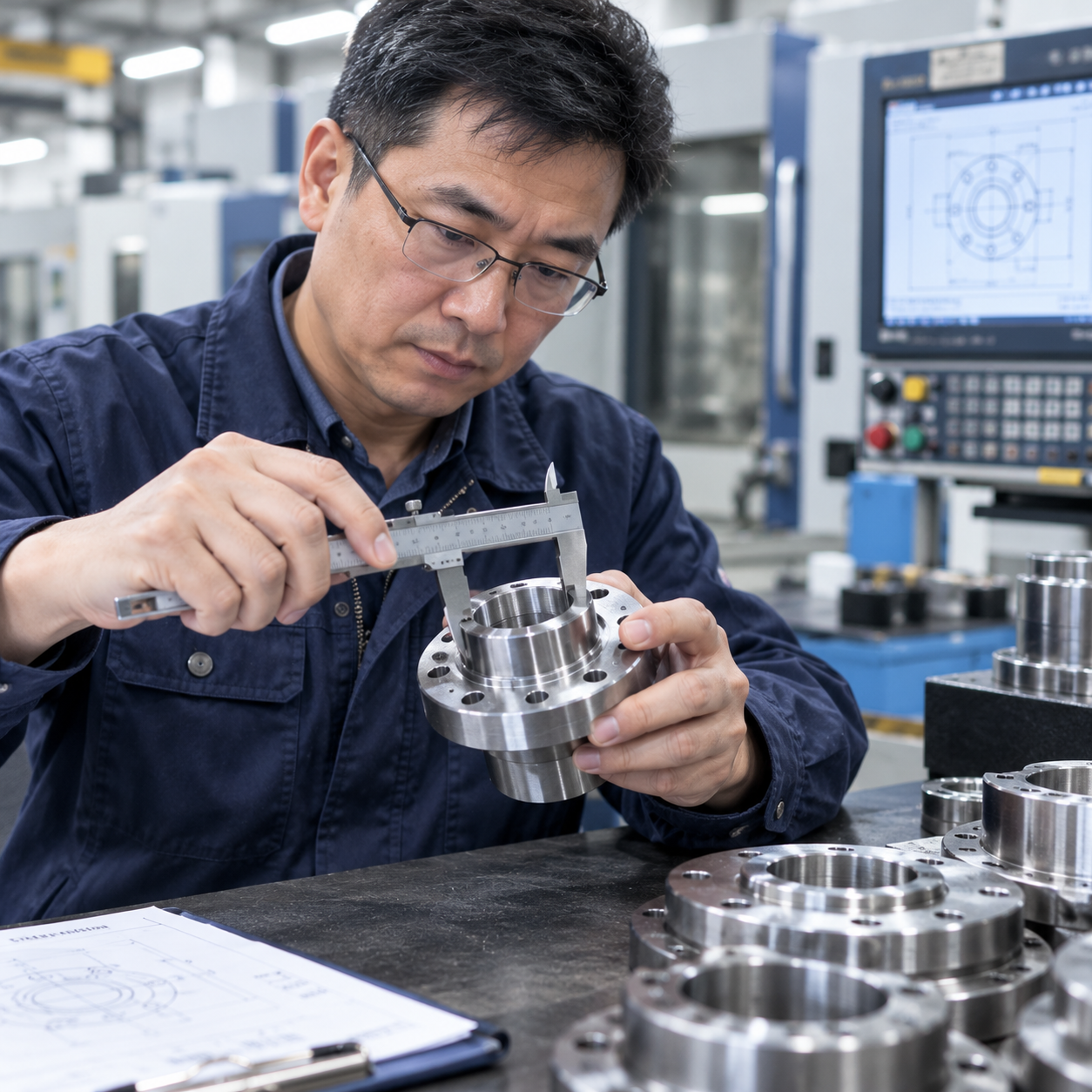
- Use CMM for complex geometry, calipers/micrometers for simple dimensions
- Check flatness, parallelism, squareness, position if called out
Material & Mechanical Property Verification
- Review material certificate (mill test report) — chemical composition and mechanical properties
- PMI (Positive Material Identification) test with XRF or OES on sample parts
- Hardness test (Brinell, Rockwell) per drawing specification
- Heat treatment report review — verify process matches specification
Non-Destructive Testing (NDT)
- Penetrant test (PT) for surface cracks on non-ferrous parts
- Magnetic particle test (MT) for surface cracks on ferrous parts
- Radiographic test (RT) for internal porosity/shrinkage (if specified)
- Pressure test for leak-tight components
Documentation Review
- Material certificates with heat number traceability
- Heat treatment records
- First-article inspection report (FAIR)
- NDT reports with acceptance standard reference
- Packing list and commercial invoice
5. Pre-Shipment Inspection Cost in China
| Inspection Type | Cost (per man-day) | What's Included |
|---|---|---|
| General PSI | $150–$350 | Quantity, visual, packaging, simple dimensional check |
| Technical PSI (metal parts) | $300–$600 | Above + PMI, hardness, CMM dimensional, NDT |
| Full NDT (RT/UT) | $500–$1,000+ | Radiographic or ultrasonic inspection with certified technician |
| Container Loading Supervision | $150–$300 | Container check, loading supervision, sealing |
Compared to the cost of shipping a defective batch overseas (return freight, rework, downtime, customer claims), PSI is an extremely cost-effective investment.
6. Third-Party Inspection vs. Sourcing Partner
You have two main options for conducting PSI in China:
Third-Party Inspection Company
Companies like SGS, Bureau Veritas, TÜV, or local Chinese inspection firms send an inspector to the factory. Pros: independent, globally recognized reports. Cons: general inspectors may not understand technical metal specs; they execute a checklist, not make engineering judgments.
Technical Sourcing Partner
A sourcing partner like GRDH Precision coordinates the inspection with the supplier, witnesses NDT, and reviews reports. Pros: understands your technical specs, can make engineering decisions, follows up on corrective actions. Cons: not fully independent (but accountable to you).
Best Practice
For high-value or critical orders, use both: a technical sourcing partner to manage the inspection and make technical judgments, plus a third-party inspector for independent verification on key items.
7. The PSI Report: What You Should Receive
Within 24–48 hours of the inspection, you should receive a detailed report containing:
- Inspection date, location, inspector name and credentials
- Purchase order number, part number, lot size, sample size
- Inspection checklist with pass/fail results for each item
- Quantitative results: dimensional measurements, hardness readings, PMI results
- Photos of samples, defects, packaging, and marking
- Overall inspection result: PASS / FAIL / PENDING (with conditions)
- Corrective action required (if any) and deadline
8. What Happens If Inspection Fails
A failed PSI is not the end of the world — it is a chance to fix problems before they cost you dearly. Here is the process:
- Hold shipment — do not allow the goods to be packed or shipped until issues are resolved.
- Classify defects — critical (must scrap), major (rework needed), minor (acceptable within limits).
- Require corrective action — ask the supplier for a root cause analysis and corrective action plan.
- Rework or replacement — supplier reworks defective parts or replaces the batch.
- Re-inspection — schedule a follow-up PSI to verify the corrective actions.
9. Conclusion
Pre-shipment inspection is the most effective way to ensure that only good parts leave China. It catches defects where they are cheap to fix and prevents the costly cascade of problems that follows shipping defective goods overseas. For industrial metal parts, invest in a technical PSI that covers material verification, dimensional inspection, and NDT — not just a visual check.
casting defects and how to avoid them." data-zh="关于铸件质量控制的更多信息,请参阅我们关于铸造缺陷及如何避免的文章。">For more on quality control for castings, see our article on casting defects and how to avoid them.
Need a Technical PSI Partner in China?
GRDH Precision coordinates pre-shipment inspection with material verification, CMM dimensional check, and NDT — only good parts leave China.
Start a Project →