Casting Defects: How to Avoid Quality Issues When Sourcing From China
Porosity, shrinkage, cracks, inclusions — casting defects can ruin a batch and delay your project. Learn the most common defects, how to detect them, and how to prevent them when sourcing from China.
TL;DR — Key Takeaways
- Common casting defects: porosity, shrinkage, hot tears/cracks, inclusions, misruns, surface defects.
- Detection methods: visual, dimensional CMM, NDT (PT/MT/RT/UT), pressure test, destructive test.
- Prevention: complete specs, first-article inspection, defined NDT acceptance criteria, pre-shipment inspection.
- Always define acceptance standards (e.g. ASTM E155 for porosity) in your purchase order.
- Pre-shipment inspection in China is the single most effective quality gate — catch defects before they ship.
1. Why Casting Defects Matter
Casting is a complex process involving molten metal, molds, gating systems, and solidification — each with many variables. Even experienced foundries produce defective parts. The difference between a good and bad casting often comes down to process control, not capability.
When sourcing from China, the risk is amplified by distance and communication barriers. A defective batch that ships overseas can cost you: rework or scrap, delayed assembly, customer claims, and the cost of returning goods. The good news is that most casting defects are preventable — if you know what to look for and how to specify requirements.
2. The 7 Most Common Casting Defects
1Porosity (Gas Pores)
Cause: Gas entrapped during solidification — from moisture in the mold, hydrogen absorbed from the melt, or turbulent pouring. Appears as round or irregular voids, usually 0.5–3 mm, on or below the surface.
Impact: Reduces pressure-tightness, fatigue strength, and corrosion resistance. Critical for valves, pumps, and hydraulic components.
2Shrinkage Cavities
Cause: Most metals shrink 3–6% during solidification. If the gating/riser system fails to feed molten metal to compensate, internal voids form. Shrinkage appears as irregular, spongy, or dendritic cavities, often at hot spots (thick sections, junctions).
Impact: Severe shrinkage can reduce load-bearing area by 20–50%, causing catastrophic failure under load.
3Hot Tears & Cracks
Cause: Hot tears form during the final stage of solidification when the semi-solid metal cannot accommodate thermal contraction — often at sharp corners, sudden section changes, or where the mold restricts shrinkage. Cold cracks form after solidification during cooling or heat treatment.
Impact: Cracks are the most dangerous defect — they act as stress concentrators and can propagate under fatigue loading. Often invisible without NDT.
4Inclusions (Slag & Sand)
Cause: Non-metallic particles (slag, dross, sand, oxide) trapped in the casting. Slag inclusions come from the furnace or ladle; sand inclusions come from the mold surface eroding during pouring.
Impact: Inclusions create hard spots that damage cutting tools during machining, and act as crack initiation sites.
5Misruns & Cold Shuts
Cause: Misrun occurs when molten metal fails to fill the mold cavity completely — usually due to low pouring temperature, slow pouring, or a design with very thin sections. Cold shut (lap) occurs when two metal streams meet but fail to fuse, creating a visible line with a rounded edge.
Impact: Missed geometry, reduced strength, and potential leak paths.
6Surface Defects (Veining, Burn-On, Penetration)
Cause: Veining is a network of raised veins on the surface caused by thermal expansion of the mold. Burn-on and penetration occur when metal penetrates the mold surface, creating a rough surface that requires extensive grinding.
Impact: Poor surface finish, increased machining cost, and dimensional deviation.
7Dimensional Deviation
Cause: Pattern or mold deformation, incorrect shrinkage allowance, core shift, or distortion during cooling. Castings can also warp during heat treatment if not properly supported.
Impact: Parts that do not fit in assembly, require extra machining, or are out of tolerance.
3. How to Detect Casting Defects
No single inspection method catches all defects. A layered inspection strategy is the most effective:
| Method | What It Detects | Best For |
|---|---|---|
| Visual Inspection | Surface cracks, porosity, cold shuts, surface finish | All castings — mandatory first check |
| Dimensional (CMM/Gauges) | Size, geometry, position, flatness | All machined surfaces, critical dimensions |
| Penetrant Test (PT) | Surface-breaking cracks, porosity | Non-magnetic materials (stainless, aluminum) |
| Magnetic Particle (MT) | Surface and near-surface cracks | Ferrous materials (carbon, alloy steel) |
| Radiographic (RT) | Internal porosity, shrinkage, inclusions | Critical pressure-containing parts |
| Ultrasonic (UT) | Internal defects in thick sections | Thick-wall forgings and castings |
| Pressure Test | Leak paths through porosity or cracks | Valves, pumps, hydraulic components |
4. How to Prevent Defects When Sourcing From China
Prevention is far cheaper than inspection. Follow these five steps to minimize casting defects before production even starts:
1Write a Complete Specification
Your drawing and specification are the contract between you and the foundry. An incomplete spec is the #1 cause of casting quality issues. Include:
- Material grade with full chemical composition and mechanical property requirements
- Heat treatment specification (solution, quench, temper, aging) with hardness range
- Tolerance class (e.g., ISO 8062-CT7 for castings)
- Surface finish requirement (Ra value)
- Inspection requirements: NDT method, acceptance standard (e.g., ASTM E155 Level 2)
- Marking and traceability requirements (heat number, part number, serial number)
2Require First-Article Inspection (FAI)
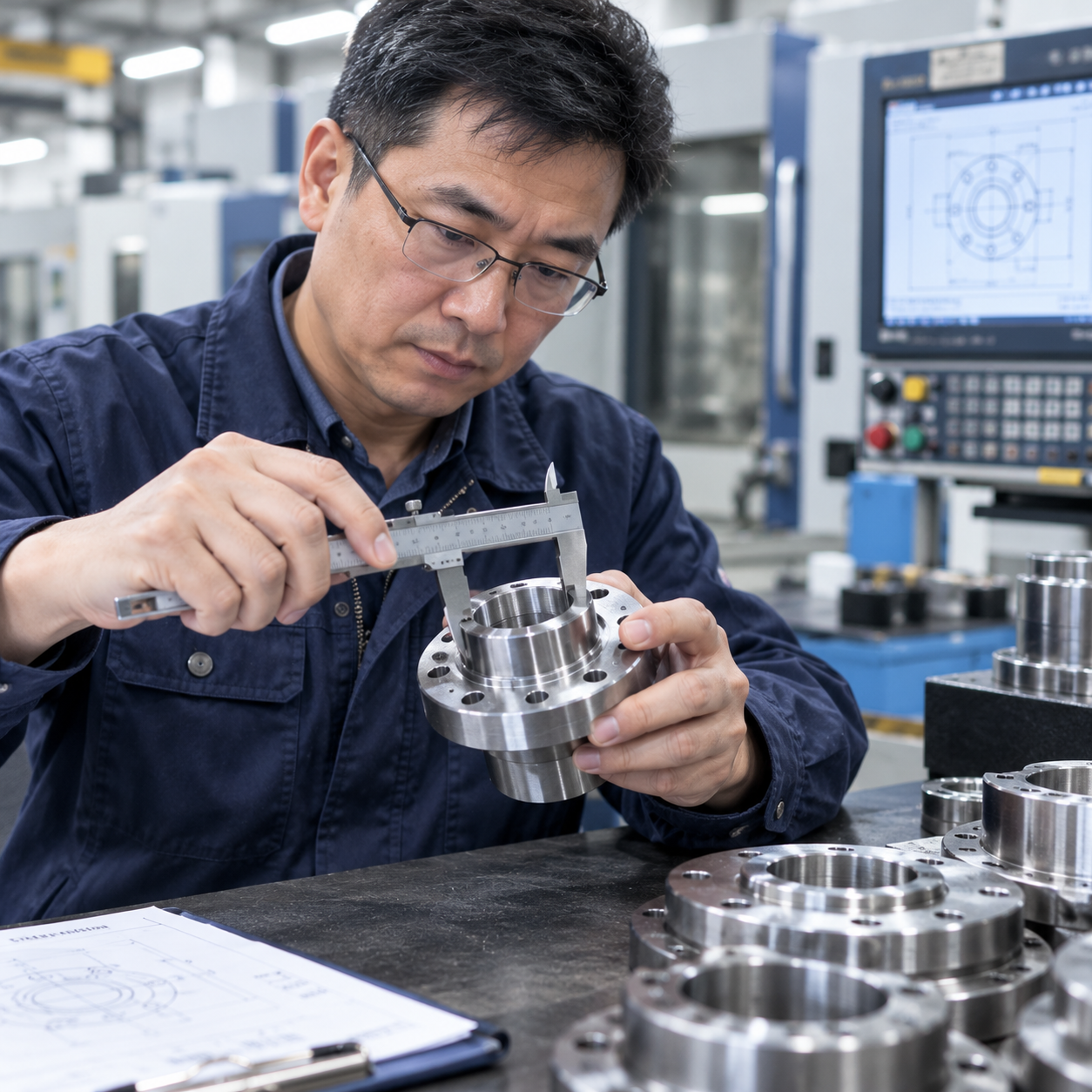
Before approving production, require the supplier to produce 1–5 first-article samples and submit a full inspection report including: dimensional report, material certificate, hardness test, and any specified NDT. Only approve mass production after FAI passes.
3Define NDT Acceptance Criteria Upfront
Do not say "no defects allowed" — all castings have some porosity; the question is how much. Reference industry standards:
- Steel castings: ASTM E155 (radiographic) for porosity, ASTM A903 (magnetic particle)
- Aluminum castings: ASTM E155 or ASTM E505
- Stainless steel castings: ASTM A609 (radiographic)
4Conduct Pre-Shipment Inspection
pre-shipment inspection in China." data-zh="这是最重要的质量关卡。货物离开中国前,对批次进行检验:目视、尺寸、材质验证(PMI)和无损检测抽检。如发现缺陷,供应商负责返工或更换——你避免了发运有缺陷的零件。详见我们关于中国发货前检验的文章。">This is the single most important quality gate. Before the goods leave China, inspect the batch: visual, dimensional, material verification (PMI), and NDT sampling. If defects are found, the supplier is responsible for rework or replacement — and you avoid shipping defective parts. For more details, see our article on pre-shipment inspection in China.
5Audit Suppliers Before Ordering
A supplier audit reveals process capability that no quote can show. Key things to verify:
- Do they have experience with similar parts (material, size, tolerance)?
- Do they have in-house heat treatment and NDT, or do they subcontract?
- What is their reject rate for similar parts?
- Do they have ISO 9001 or industry-specific certifications (IATF 16949, API, etc.)?
The 80/20 Rule of Casting Quality
80% of casting defects come from 20% of root causes: (1) incomplete specification, (2) wrong process selection, (3) no pre-shipment inspection. Get these three right and you eliminate most quality problems.
5. What to Do When Defects Are Found
Even with the best processes, defects happen. Here is how to respond:
- Isolate the batch — do not ship or use suspect parts until inspected.
- Identify the defect type and extent — is it surface porosity that can be repaired, or internal shrinkage that requires scrap?
- Determine root cause — was it process, material, or design? Get a corrective action report from the supplier.
- Decide: repair, rework, or scrap — repair only if the customer's specification allows it and the repair procedure is approved.
- Update the specification — add clearer requirements to prevent recurrence.
6. Conclusion
Casting defects are inevitable in the casting process, but most are preventable with proper specification, supplier selection, and inspection. The biggest mistake buyers make when sourcing from China is treating quality control as an afterthought. By defining requirements upfront, requiring first-article inspection, and conducting pre-shipment inspection in China, you can ensure that only good parts reach your facility.
How to Source Investment Castings From China." data-zh="关于从中国采购铸件并内置质量控制的完整指南,请参阅我们的文章:如何从中国采购熔模铸件。">For a complete guide on sourcing castings from China with quality control built in, see our article: How to Source Investment Castings From China.
Need a Quality Control Partner in China?
GRDH Precision audits suppliers, coordinates first-article inspection, and conducts pre-shipment inspection — so only good parts leave China.
Start a Project →