Open Die vs Closed Die Forging: Which Is Right for Your Parts?
Choosing between open die and closed die forging affects tooling cost, lead time, tolerances, and total part cost. This guide breaks down both processes so you can make the right call.
TL;DR — Key Takeaways
- Open die forging: low tooling cost, loose tolerances (±1.5–3 mm), heavy machining allowance, ideal for large/simple parts and low volumes.
- Closed die forging: higher tooling cost, tight tolerances (±0.25–0.5 mm), near-net-shape, ideal for complex parts and volumes of 200+.
- Lead time: open die 2–4 weeks; closed die 4–8 weeks (includes tooling).
- Part size: open die 1 kg to 100,000+ kg; closed die 0.1 kg to ~200 kg.
- Both improve grain structure and mechanical properties vs. raw bar, but closed die gives better fatigue life.
1. What Is Forging?
Forging is a metalworking process that shapes material using localized compressive forces. Unlike casting, which pours molten metal into a mold, forging deforms solid metal (usually heated above its recrystallization temperature) under pressure. This aligns the metal's grain flow with the part's geometry, producing superior strength, toughness, and fatigue resistance compared to machined-from-bar or cast parts.
The two most common forging methods are open die forging and closed die (impression die) forging. The choice between them is the single biggest decision in any forging sourcing project.
2. Open Die Forging: How It Works
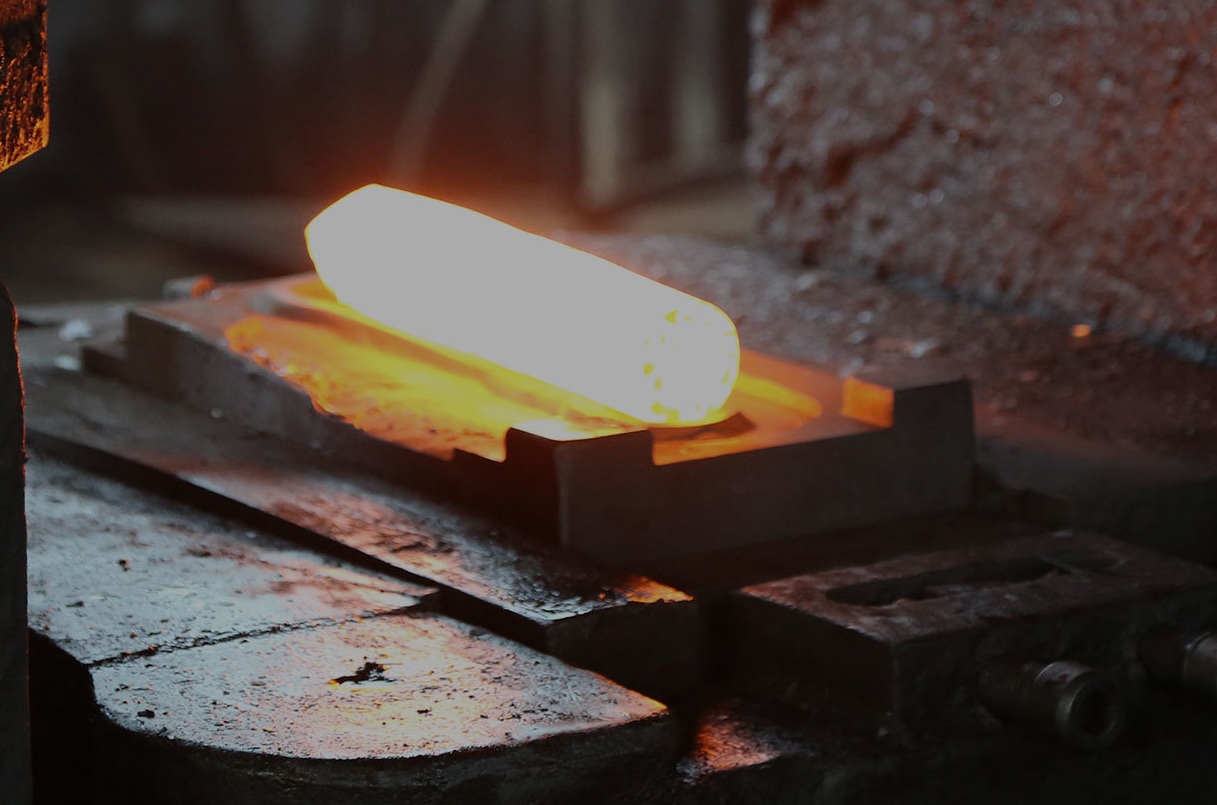
Open die forging (also called free forging or hand forging) uses flat or simply-shaped dies that do not completely enclose the workpiece. The operator manipulates the hot billet between the dies, rotating and repositioning it to gradually shape the part to the desired dimensions.
Because the dies do not contain the final part geometry, open die forgings are approximate shapes — essentially "oversized blocks" that must be machined to final dimensions. Typical machining allowance is 3–6 mm on all surfaces.
Best For
Large, heavy parts (shafts, rings, cylinders, blocks), simple geometry, low-to-medium volumes (1–200 pieces), and applications where material size or weight makes closed die tooling impractical.
Advantages of Open Die Forging
- Low tooling cost — dies are simple and reusable; no dedicated tooling for each part.
- Fast lead time — no tool manufacturing needed; first parts in 2–4 weeks.
- Unlimited part size — can forge parts from 1 kg to 100,000+ kg.
- Full grain refinement — repeated working breaks down coarse grain structure.
Disadvantages of Open Die Forging
- High machining cost — 3–6 mm machining allowance on all surfaces means significant material removal and CNC time.
- Loose tolerances — ±1.5 to ±3 mm; not suitable for precision features.
- Limited geometry — cannot produce undercuts, complex pockets, or intricate details.
- Lower material yield — 30–50% of forged weight may become machining scrap.
3. Closed Die Forging: How It Works
Closed die forging (also called impression die forging) uses two die halves — an upper and lower die — each machined with a cavity (impression) that mirrors the final part geometry. The heated billet is placed in the lower die, and the upper die descends under high pressure (hundreds to thousands of tons), forcing the metal to flow into the die cavity.
Excess metal squirts out as "flash" around the parting line, which is trimmed in a subsequent operation. The result is a part very close to final shape — typically 0.5–1.5 mm machining allowance.
Best For
Parts with defined, moderately complex geometry (gears, connecting rods, brackets, valve bodies), medium-to-high volumes (200+ pieces), and applications requiring good fatigue properties and material efficiency.
Advantages of Closed Die Forging
- Near-net-shape — 0.5–1.5 mm machining allowance reduces CNC cost and material waste.
- Tight tolerances — ±0.25 to ±0.5 mm; some critical features ±0.1 mm.
- Complex geometry — can produce ribs, bosses, pockets, and moderate undercuts.
- Optimum grain flow — grain follows part contours, maximizing fatigue strength.
- High repeatability — consistent dimensions across thousands of pieces.
Disadvantages of Closed Die Forging
- Higher tooling cost — die sets cost $2,000–$30,000+ depending on part size and complexity.
- Longer lead time — tool manufacturing takes 3–6 weeks; total 4–8 weeks to first sample.
- Part size limited — typically 0.1–200 kg; large presses can handle up to 500 kg.
- Design constraints — parting line, draft angles, and flash must be considered.
4. Side-by-Side Comparison
| Factor | Open Die Forging | Closed Die Forging |
|---|---|---|
| Tooling Cost | Low ($0–$1,000) | High ($2,000–$30,000+) |
| Lead Time (first part) | 2–4 weeks | 4–8 weeks |
| Tolerance | ±1.5–3 mm | ±0.25–0.5 mm |
| Machining Allowance | 3–6 mm | 0.5–1.5 mm |
| Part Weight Range | 1 kg – 100,000+ kg | 0.1 kg – ~200 kg |
| Geometry Complexity | Simple (blocks, shafts, rings) | Moderate (ribs, pockets, bosses) |
| Material Yield | 50–70% | 80–95% |
| Best Volume | 1–200 pcs | 200+ pcs |
| Surface Finish | Ra 6.3–12.5 μm | Ra 3.2–6.3 μm |
5. How to Choose: A Decision Framework
Use the following questions to guide your process selection:
Question 1: How complex is the part geometry?
If your part has ribs, pockets, bosses, non-circular cross-sections, or any feature that cannot be produced by simple reduction — closed die forging is required. Open die forging can only produce shapes that are roughly rectangular, cylindrical, or ring-shaped.
Question 2: What is your annual volume?
Closed die tooling costs are typically amortized over 200–500 pieces. Below that threshold, open die forging (even with higher machining cost) is usually cheaper. Above it, closed die forging wins on total cost.
Question 3: How large is the part?
Parts over ~200 kg are almost always open die forged — the cost and size of closed die tooling and presses become impractical. Parts under 200 kg can go either way, depending on complexity and volume.
Question 4: What tolerances and finish do you need?
If your drawing specifies tolerances tighter than ±1 mm, closed die forging is the better starting point. If ±2–3 mm is acceptable and the part will be fully machined anyway, open die forging is fine.
Quick Decision Rule
Simple shape + large part + low volume → Open Die.
Complex shape + small/medium part + 200+ volume → Closed Die.
6. A Real Cost Example
Consider a steel connecting rod, 5 kg, annual volume 1,000 pieces, requiring 1 mm machining allowance and ±0.5 mm tolerances:
| Cost Element | Open Die + Machining | Closed Die + Machining |
|---|---|---|
| Tooling | $0 | $8,000 |
| Forging/pc | $18 | $12 |
| Machining/pc | $35 | $10 |
| Total/pc | $53 | $22 + $8 tooling amortization = $30 |
| Total for 1,000 pcs | $53,000 | $30,000 |
At 1,000 pieces, closed die forging saves approximately 43%. At 100 pieces, the open die route would be cheaper ($5,300 vs. $3,000 + $8,000 tooling = $11,000).
7. Sourcing Forgings From China
China has a mature forging industry with capacity ranging from small open die shops to 10,000-ton closed die presses. Sourcing from China typically saves 30–50% compared to Western forging suppliers. However, the forging process has several quality risks that buyers must manage:
- Forging temperature control — if the billet is too cold, forging can cause internal cracks; if too hot, grain growth reduces toughness.
- Die maintenance — worn dies produce out-of-tolerance parts and poor surface finish.
- Heat treatment — wrong quenching or tempering can leave the part too soft, too brittle, or with residual stress.
- Material substitution — some suppliers use lower-grade steel to save cost.
How to Source Forged Parts From China — Complete Buyer's Guide." data-zh="关于从中国采购锻件的完整指南,请参阅我们的文章:如何从中国采购锻件——完整买家指南。">For a complete guide on sourcing forged parts from China, see our article: How to Source Forged Parts From China — Complete Buyer's Guide.
How GRDH Precision Helps
We audit forging suppliers by press capacity, die-making capability, heat treatment equipment, and NDT capacity. We verify material certificates and heat numbers, witness first-article inspection, and coordinate pre-shipment inspection to ensure every forging meets your specification before it leaves China.
8. Conclusion
The open die vs. closed die decision comes down to a simple trade-off: open die trades precision and material yield for low tooling cost and fast lead time; closed die trades higher tooling cost and longer lead time for near-net-shape parts and lower per-piece cost at volume.
When in doubt, send us your drawing and volume — we will recommend the right forging method and identify qualified Chinese suppliers to execute it.
Need Help Choosing the Right Forging Method?
Send us your drawing and annual volume — we will recommend open die or closed die forging and source it from qualified Chinese forging shops.
Start a Project →